Tuesday, 21 May 2013

Resurrection and Staying Alive

CPH 16 back at Mount Windeatt
Don't worry, this post has nothing to do with religion or music!

In February 2012, I mentioned that the CPH had been withdrawn from service. It had never run well and I was not satisfied with the electrical pick up arrangements.  At the time, I contemplated the purchase a new chassis and motor but other priorities intervened, as they do, and so the CPH just sat in the staging area.

Over the intervening 15 months, I have read a number of blog posts and articles about 'Stay Alive' or 'Keep Alive' capacitors being used as a way to overcome short term losses of power. From what I read, this seemed like a solution for my 30 Class tank locomotive and, to a lesser extent, my 50 Class. Despite having some additional pick-ups fitted, both still stall in particular locations on the Atlas points that I purchased back in the late 1990s.Yes, I could replace the points but that will be a major task probably causing a significant amount of damage to finished scenery. Hence attention has turned to the concept of the uninterrupted power supply.

Not having any experience with these and having no feel for the extra space that the Stay Alive would take, I decided to use the CPH as a trial. After a bit of investigation, I purchased a DCC Concepts decoder and 'stay alive' capacitor. However, I compromised the trial somewhat by also upgrading the electrical contact wipers on the unpowered bogie using the same Hollywood Foundry product that I had used for the 36 Class.( http://philipscreek.blogspot.com.au/2012/10/power-to-36.html)

The 'Stay Alive' is the blue object on the left
The upgrade of the wipers worked well and improved the performance of the CPH to some extent, but I'm not sure about the new decoder and stay alive. I did try to test the stay alive by running it over an unpowered section of track but The CPH  stopped dead. When I asked the manufacturer about this, he politely told me that I would need a capacitor about ten times larger than the one I purchased to get the result I sought! So in one respect, the trial delivered an answer and the CPH is back in service  but I need to keep searching for a solution.

Clearly when it comes to 'stay alives', size does matter!


Tuesday, 26 March 2013

Evolution or a Lack of Planning?

One of the non railway projects that I have been undertaking over the past few weeks  is to digitise a number of old family VHS from the mid 90s. It was certainly a trip down memory lane, and one of the segments that I uncovered was some video that I had taken of Philip's Creek in its earliest iteration in our garage in Missouri.

It highlighted how much Philip's Creek has evolved since 1996 reflecting changes in space availability and operations. For example, when the original video was taken, Philip's Creek was a continuous layout; it is now a point of point operation. Then, it occupied a space of 3.6m x 1.8m. Now it is 1.8m longer and is now a 'L+' shape. It has also moved from the original DC control to DCC.

However, some things haven't changed. The modular arrangement has withstood the test of time and  many moves. The concept of a complete styrofoam base has made it light enough to move, but has also proved to be very stable. The prototype and time era has not changed although as I mentioned a while ago, an element of elasticity has crept into the time period.

To illustrate the changes, I have attached three photos, all of which show the same location on the layout but each separated by about 8 to 9 years. The first photo shows one section of the layout as it was originally constructed at the end of 1996 as part of the continuous track plan. The second photo shows the same area as it was around 2005. The section of through track had now become the coal mine siding. Finally, the third photo show it in its current iteration as a locomotive siding.  

Philip's Creek 1996
Philip's Creek 2013

Philip's Creek 2005


While some changes have been possible because of extra space, some have been the result of changes in the way the layout is operated.  I would like to say that these reflect an evolution of my modelling but when I look at the detailed planning done by others, combined with the time they commit to get it right, I'm not so sure. I know my own eagerness to get something running, and the reality is probably more a lack of planning, or perhaps, a lack of adherence to the plan on my part. The only thing I can say in my own defence is the old cliché about 'change being a constant' on the prototype and therefore, I am modelling that change - well at least, that's my story and I'm sticking to it!


Sunday, 10 March 2013

A Change of Scale Weekend

This weekend saw a focus on 1:1 scale locomotives rather than the usual 1:87 version. This is just a quick post with a few photos that may be of interest.

Yesterday, my wife and I took a trip from Sydney to Wollongong hauled by 3642 looking resplendent in its green livery. It was a great trip with a interesting return journey by sea but I have to acknowledge that there was considerably more vertical and lateral movement on the return journey. Fortunately, my lunch stayed where it should for that trip.


This morning, we also heard the unmistakable whistle of a steam locomotive around Hornsby where we live. A quick check of the internet indicated that 3016, normally resident in Canberra, was operating in the area. So this afternoon, there was a quick trip to a nearby overpass to capture a few photos capture 3016 as it returned to Central.

A 36 class is already part of the Philip's Creek roster but a 30T remains on the wish list.


Thursday, 7 February 2013

A New Lease of Life

From a modelling perspective, it's been been a fairly quiet month, as work and family activities have occupied my time and attention. However, I have managed to spend a few hours on the hobby,  with the focus returning to the CCH fleet as well as upgrading my two old Powerline MHGs.

However, for this post, I wanted to spend a few moments on the development of the new coal train as a whole, and the extra lease of life that it seems to have given to my elderly 50 class locomotive. I already operate one coal train, pulled by 6018, that regularly passes through Philip's Creek to somewhere further up the Hunter Valley.  This consists of a dozen larger BCH wagons assembled from kits quite a few years ago. The original intention was for this train to pick up coal from the mine at Philip's Creek, but the frequent derailments of the 60 class caused a rethink and the second coal train was born, this time based on the smaller, "quaint" CCH and LCH wagons. Yes, I know there are two BCH wagons in the photos but they may disappear as the four wheel fleet grows.

5131 was the first white metal kit that I tackled shortly after converting back to HO scale. It is a bit rough compared to its brass and factory manufactured colleagues but is a sentimental favourite. It has been re-engined once, as well as receiving much attention and attempts at fine tuning, albeit with only limited success. In times of frustration, I have even considered converting it to a static model.

I don't know if it's my imagination, but since being assigned to the new role 5131 seems to run a lot smoother and more reliably. I may have just invoked Murphy's Law and it could return to its old ways, but hopefully, 5131 will soldier on for the foreseeable future.

One other surprise addition to the coal train was the CHG brake van. Santa (aka Gen Y son) left it under the Christmas tree. I had contemplated purchasing one at Liverpool last year but opted for two MHG vans instead. Nor was it on the Christmas wish list, but a frantic call from son just before Christmas, having left things a bit late for internet shopping, provided an opportunity for a spot purchase from the local hobby shop.

And so to finish this post, I thought I would step back, literally, and provide a longer distance view of the coal train on approach to the mine.


Thursday, 3 January 2013

Track and Wheel Cleaning

An update incorporating 12 month's experience since the original post is at http://philipscreek.blogspot.com.au/2014/01/woodland-scenics-track-and-wheel.html
A further update showing repairs to the track cleaning tool is at It Broke and the final chapter in the saga is at Track-cleaner v3.0

I find track and wheel cleaning to be real chores but are maintenance tasks that must be done regularly if we want our expensive locomotives to operate as they should. I'm really looking forward to the day when locomotives are powered by rechargeable batteries and controlled by radio signals. Where all this will fit in a HO scale locomotive, I don't know, but I have read some articles suggesting that it's coming. However I digress.

We all have our favoured means of cleaning. I have tended to use either a cork sanding block or champagne cork saturated with white spirit for the track. For the wheels, I used a combination of  a cotton bud again dipped in white spirit and/or running the locomotive over a piece of masking tape fixed to the track. The track cleaning methods worked reasonably well but I consistently ran foul of any object that projects more than about 20mm above the track. The wheel cleaning worked to some extent but I was never sure that I had cleaned the whole wheel, and it was very tedious.

I went searching to see what might be available as a relatively inexpensive solution and happened on two products put out by Woodland Scenics to tackle track and wheel cleaning respectively. Both were purchased over the Christmas period but unfortunately Santa didn't help with either.

I though it may be useful to provide some first impressions of both tools.The manufacturer's web site provides details of each product so I won't attempt to repeat that information here. These can be found at:   http://woodlandscenics.woodlandscenics.com/show/item/TT4561/page/1 and http://woodlandscenics.woodlandscenics.com/show/item/TT4550/page/1 


Firstly to the wheel cleaning tool. The product was set up as per the manufacturer's instructions. Several locomotives, both diesel and steam, were cleaned but the results were inconclusive. Each locomotive had similar results. There was some slight evidence of wheel dirt on the white cleaning pads but there was also traces of dirt on the cotton wool ball (soaked in white spirit)  that I wiped over the bottom of the driving wheels after the initial clean. ( It is the white object above the last right hand driving wheel of 5131). Either the wheels of my locomotives were cleaner than I thought, or the product did not work as well as it was intended. The jury is still out and I think I may have to fiddle with it a bit to see if I can get a better result.

The track cleaner is a different story. I found the swivel handle to be a real positive although it does take some concentration to stop it slipping off the track.

There are four different types of pads provided. Two are felt and two are a rubberised compound similar to pencil and ink erasers. I have tended to use the white rubberised pads for most of my regular cleaning activities. The pads are reversible with one side grooved to allow it to follow both HO and N scale track. This process works reasonably well for code 100 track but I found that my ballasted code 83 track caused the pads to foul. The manufacturer recommends that the flat side of the pads be used to clean point work but I have found it best to use this configuration across all of my track.

The kit also includes a bottle of cleaning fluid. It does clean the pads but I don't think it will last too long. I'm not sure what it contains but I think I'll be looking for substitutes.

I believe this is a handy tool for track cleaning and it will certainly get regular use on Philip's Creek.

As I said at the start, there are many ways to clean tracks and wheels. As a final point, if you are interested in purchasing either product,  I recommend that you do some comparisons between suppliers as I found a wide variety of pricing.

Happy New Year to all.


Monday, 17 December 2012

"So this is Christmas"


"So this is Christmas
And what have you done
Another year over
And a new one just begun
Ans so this is Christmas
I hope you have fun
The near and the dear one
The old and the young"  
     (John Lennon)


And what have you done
Another year over

John Lennon's song started to play in my mind last Saturday  as I was setting up the Christmas tree for another year. It started me thinking about what I have achieved from a modelling perspective over the last 12 months and whether it has been been fun?

The answer to the second question is easy, yes, although occasionally a bit frustrating. The answer to the first questions is a bit more complex. 

It has been a year in which some overdue tasks were addressed, the silo, the Mount Windeatt backdrop and fencing details:
http://philipscreek.blogspot.com.au/2012/06/silo-progress.html  
http://philipscreek.blogspot.com.au/2012/07/more-silo-progress.html
http://philipscreek.blogspot.com.au/2012/04/backdrop-progress.html
http://philipscreek.blogspot.com.au/2012/11/a-waste-of-time.html

Incidentally, the silo still resides on display in the family room because there is no place for it on the layout as yet and the fencing has not advanced any further than what was described in the post.

It has also been a year of  upgrading and learning, particularly additional detail for the EHO and the CCH/LCH fleet:
http://philipscreek.blogspot.com.au/2012/05/paint-stripping-and-other-progress-on.html
http://philipscreek.blogspot.com.au/2012/08/the-eho-hopefully-getting-little-closer.html
http://philipscreek.blogspot.com.au/2012/10/more-on-cch-two-down-14-to-go.html

The next coal wagon (this time a LCH) is now nearing completion and, hopefully, will be in service just after New Year.

The year also saw some opportunity purchases that have added to the roster, the 36 Class ( http://philipscreek.blogspot.com.au/2012/10/power-to-36.html ), the EHO, the start of the CCH/LCH fleet and two new  MHGs have been the major acquisitions in 2012 . The latter purchase has allowed me to commence an upgrade program for my original Powerline MHGs.

Commercially, it has also had some frustrations as some long overdue orders have failed to appear. Hopefully, 2013 will see the addition of the Trainorama 48 class and the SDS three dome tanker set.

Finally, it has also been a year of planning, re-planning and more re-planning as I have struggled to decide how best to extend the layout:
http://philipscreek.blogspot.com.au/2012/02/next-phase.html
http://philipscreek.blogspot.com.au/2012/07/which-way.html 


Right now I am up to Plan C, that looks more like Plan A than Plan B!

And a new one just begun

So what is planned for 2013, assuming the Mayans have got it wrong.

One piece of good news is that another relocation does not appear to be on the horizon for at least 12 months - I've probably jinxed myself now!

As mentioned earlier, I would like to think that the commercial products that I have had on order will finally arrive.  Certainly, the CCH/LCH construction program will continue and the MHG upgrades will be completed but beyond that, I'm not sure. No doubt there may be some opportunity purchases but that will depend, in part, on what emerges during the year (ready to run or kits).

As for the layout, I would like to think that I can make a start on the expansion plans. I do know that the growth in the rolling stock roster is starting to put some pressure on the staging areas. They are getting quite crowded.

I hope you have fun
The near and the dear one
The old and the young

And so in closing for 2012, I would like to take this opportunity to wish all those who read this post, as well as your "near and dear ones", a very Merry Christmas and a Happy New Year for 2013.


Wednesday, 21 November 2012

A Waste of Time?

We enjoy most activities associated with this hobby - we wouldn't be involved in model railways if we didn't. When it comes to layout construction jobs, most people have strengths and weaknesses, and, as such, are better at some tasks than others. For me, I am happiest adding the finishing details rather than the basic work required to construct the baseboard, lay the track and install the wiring. While I am capable enough to complete these activities, they are something that must be done rather than something that can be enjoyed. For me, wiring is a particular chore. However, over the past week or two, I have come across a scenery construction task that is almost as bad and it too involves wire. I am talking about fence building.

This was a job that kept sliding down the 'to do' list until I ran out of excuses for not doing it. In NSW, most rural areas, by the 1960s, had well established fences. I had constructed a few around specific buildings, one particular house and the water treatment plant. However, the glaring omission was a fence between the rail easement and the Philip's Creek village. I had previously purchased a few packets of the Kerroby Models wire fences to provide the fence posts and, in my late father's workshop, I found some very light gauge wire. This was very very old wire that had cloth rather than plastic insulation. In fact, the wire is that old that I suspect that my father may have acquired it from his father who used to work in the NSW Railways Electric Car Workshops at Chullora in the 1930s to 1950s. So another convoluted reason why I should stop procrastinating.

The fence line with the bottom three wire strands fitting - and barely visible!
So I was set! The fence posts were painted and then planted, and then the problems started. Threading the wire through the holes in the fence post was quite a challenge. When I was young, my mother would often ask me to thread a needle for her because "my eyes were younger than her's". Well, now, my eyes are not so young anymore, and I have no children left at home to ask. Even with my strongest set of reading glasses, it has proved to be a challenge particularly as each post is spaced about 50mm apart and there are five holes per post. I have ended up using a torch to backlight each post to give a better view of the holes.
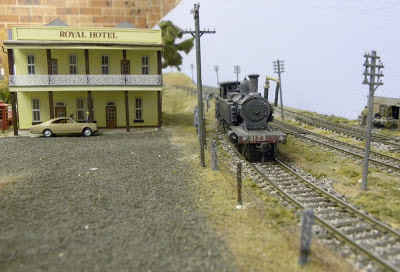
Another view of the fence - the Royal Hotel has suffered a bit during construction
The other challenge has been working around the urban encroachment of Philip's Creek. Some smaller items could be moved but power poles and the Royal Hotel have caused more than a few problems, and there has been some minor damage to both.

At the time of writing, this section of fence is only 60% completed and I'm beginning to think that I have wasted my time. There are still quite a few metres of fencing to finish. Maybe, I should have just planted the fence posts to create an optical line and let people's imagination do the rest. Certainly, the wire is barely visible in the accompanying photos. This probably means the gauge of the wire is about right but this activity has convinced me never to attempt power and telegraph line reticulation!!

However, not wishing to close on a negative note, I have added a few photos of the latest additions to the Philip's Creek roster, the recently weathered 36 class (that sound like a contradiction of terms) and the four completed CCHs.