Showing posts with label scenery construction. Show all posts

Friday, 19 December 2025

Christmas 2025

For the last six months or so, I have been slowly refurbishing the Mount Windeatt module, essentially converting it to a 'stand alone' shelf layout while still sharing the lower 'back of house' staging area. This change was foreshadowed in an earlier post this year.( https://philipscreek.blogspot.com/2025/03/a-bridge-too-far-or-moving-to-next-job.html ) As I mentioned in the post, the inspiration for this line is the Dorrigo branch line and the purchase of 1919 was a "necessary" part of this conversion. However, the HOn3 logging railway indulgence also retains its place on Mount Windeatt. 

To date, the old layout and scenery has been removed and most of the HO and HOn3 track recovered. Both types of track have now been relaid although I had to supplement the HOn3 portion with four lengths of  new Peco track. I have to say that I found the Peco track much easier to work with than the original Shinohara track. Rodding has been installed to operate all points. Trains have been running over the revised layout to confirm there are no problems. So far so good! The following video shows 1919 bringing a rake of empties into Mount Windeatt .

My focus has now turned to the scenery. The buildings have been roughed into their new locations and styrofoam has been installed to shape the rising ground leading to the timber harvesting areas beyond the limits of this module.


Progress to date has been slow for a variety of reasons unrelated to the hobby but, hopefully, landscaping can be achieved in the next six months - we shall see.

However, the end of 2025 will arrive much sooner and this will be my final post for the year. While the terrible event of Bondi casts a dark shadow over Christmas this year, I'd still like to take the opportunity to wish all readers, as well as your "near and dear ones", best wishes for Christmas and for a happy 2026.


Thursday, 10 October 2024

More Terraforming and Detailing


Work has continued on the remodeling of Philip's Creek.  The bulk scenery work has been completed on the southern end of Philip's Creek up to the creek itself.

With that work completed, some details have been added including fence posts, telegraph and power poles, some trees, and vehicles.


In addition, I pasted a cropped Google Streetview image from Carcoar to the backdrop to add some depth to the main street. Yes, I know Carcoar is a bit further west than my modelling area but it was a good fit. Also, when the focus is on objects in the foreground, the background becomes less of an issue.


The focus has now moved to the northern end of Philip's Creek with the current effort on shaping the landforms before the application of the fabric and then coloured tile grout. Once again, the 50/50 mix of PVA and water will get a major workout.


Friday, 26 July 2024

The Biological Clock is ticking

In my most recent post, I concluded with the comment that my biological clock is ticking, and indeed it is!

Philip's Creek, in one form or another,  has now been in existence for almost 30 years. As I am now 70, I probably won't have the opportunity to invest another 30 years on the layout. I don't want to be morbid about this but I recognise that my remaining time is limited.  I'd like to get the layout substantially complete in or about the next five years so that I can enjoy it before my energy, enthusiasm and/or capability fall away.

This is not the first time my biological clock has impacted on my railway modelling. For most of my early life, my family lived at Normanhurst, a northern suburb of Sydney. My father fixed my train set to a board in the garage creating my first model railway layout. The only problem was that it was hinged on the wall and could not be used when the car was in the garage, so everything had to be unpacked and then repacked each time I wanted to run my trains.

In 1969, my parents decided to move to a bigger house in Wahroonga, an adjoining suburb. The bonus for me was that there was a small room available under the house where I could set up my layout permanently. I quickly took advantage of this and built a new layout including basic scenery. However, my lack of planning led to frustration and within the space of about 12 months, that layout was also dismantled. A third layout was constructed to the point where track was laid and trains could be run but there was no scenery. But then, the biological clock interposed and I started to focus on members of the opposite sex. I also learned, very quickly, that mobility was a key enabler for that pursuit. Consequently, I also had to learn how to maintain and repair old cars, a task much simpler then than these days. Very quickly, the layout and 'train room' became a storage area for car parts and spares. A few years later, the uncompleted layout was dismantled and packed into boxes. It took quite a few more years to work through that biological clock impact and get back to modelling.

Coming back to now, so what do I mean by "substantially complete"? The following is a summary of the tasks I'd like to complete to achieve that state.

Scenery around Philip's Creek station completed and backdrops painted.

This is the largest single job and work is well underway. It was the subject of my most recent post.


Quarry Module.

The quarry module is a discrete entity on the lower level and is a complete new build. The quarry siding branches off the main line just north of the Hunter River bridge. The module fits under the helix and requires the operator to move to a different operating position.


 Halls Creek and Kingston Plain Modules

These modules require some adaption from their positions on the previous iteration of the layout at Hornsby. The Halls Creek bridge module needs to be widened and the Kingston Plains module approach needs to be repaired after a track realignment. In addition, the Kingston Plains and Halls Creek backdrops need to be integrated.


The Mount Windeatt Modules.

The Mount Windeatt module needs be refurbished and the adjoining module is to be sceniced. The Mount Windeatt backdrop will also be extended to conceal the Singleton staging area behind it.


To get to my "substantially complete" state, I will be focusing on finishing the major items of each module. More detailed work such as small mini scenes or automation will be left to later as or when I am motivated.

The reader will notice that this is all about scenery. While individual items of rolling stock may be acquired, there are no glaring gaps in the rolling stock fleet. I'm still patiently waiting on SDS D53 Class but that's the only future planned motive power acquisition. However, a further rollout of sound for some locomotives is on the agenda.

But enough writing, as I said before, the biological clock is ticking!


Sunday, 26 May 2024

Another Grandfather's Axe


Almost 10 year ago, I wrote a post about a rebuild of an old US tank wagon as a NSWGR 9000 gallon wagon (A 36ft Tank Wagon aka Grandfather's Axe). I was reminded of this post as I started significant scenery work on the upper level of the layout and the refurbishment of the Philip's Creek township. This part of the layout has remained fairly stable since around 2008. By 2018-19, I was speculating about a refresh of the scenery to bring the Philips Creek modules to the standard of the more recently constructed modules. 

However, the downsizing move in 2020-21 has changed that intent. The layout has been significantly reworked and the Philip's Creek modules, in particular, are having a major makeover and this begs the question; as these are the heart of the layout, is it still Philip's Creek? According to Wikipedia, this conundrum is known as the Ship of Theseus, or Theseus's Paradox, which asks whether an object is the same object after having had all of its original components replaced over time, typically one after the other. Is it still 'grandfather's axe'?

Frankly, the short answer is that it doesn't matter. Philip's Creek is model of a fictitious location and it can take whatever form I need it to take. Therefore, it still is 'grandfather's axe'. So enough of the philosophical deep thinking, what's actually happening at Philip's Creek? In short, a fair bit! 

The two photos below show Philip's Creek around 2018.


And the next two photos show Philip's Creek in its emerging form with the terraforming process well underway. The hotel, shops, war memorial and creek have not changed locations and can be used as reference point for a comparison between photos. 

The track on the Philip's Creek modules was lifted and relayed. In essence, the modules were reversed in relation to other modules of layout, that is the Singleton end became the Muswellbrook end and visa versa. The actual station has also been relocated towards the centre as a major passing location for north south traffic and shunting opportunities at either end.

The backdrop has been added and will be painted once the basic terrain colours have been established.

The road bridge, the subject of my most recent post now becomes a significant feature of the station precinct. The earthworks at either end of the road over bridge have now been constructed.

Three of the major buildings have been replaced by new structures. The older structures were all LJ cardboard kits built in the late 1990s. While great kits in their day, after 20 plus years, they were tired and showing their age. 


All three buildings were replaced by similar kits from the Walker Models range. They were all easy to assemble which was fortunate because I suspect the instructions to be challenging for novice modeller. 


The Royal Hotel replacement was interesting. Dimensionally, it was an exact replacement for the LJ kit and dropped directly into the place where the old kit had resided.


In addition, I have added a flour mill at the northern end of town. It provides an additional industry and a destination for wheat from Kingston Plains, enhancing the operation of the layout.

One of the consequences of the reversal is that the backdrop is now obstructs one of my favoured photo locations in the vicinity of the Philip's Creek road bridge. That means that the photo header for this blog can never be repeated and the best available is the photo opposite. Unfortunate but in the overall scheme of things, insignificant.

So, back to work, my biological clock is ticking!


Saturday, 16 December 2023

Hunter River Bridge - Finishing the scene - 1

Following on from my recent post, finally, the scenic work has closed up on the Hunter River. While the work modelling the banks and the littoral areas is fairly routine, modelling the wide expanse of water flowing under the bridge will be a bit more challenging.  

As usual, the landform is foam board, carved and shaped around the bridge abutments. The following photos show the river banks before the final shaping.  These were topped with the domestic wipe disposable towels topped with coloured tile grout and, as usual, there was liberal use of 50/50 PVA glue and water.  My biggest fear while doing this work was accidental damage to the bridge. Fortunately, that didn't happen.

With the banks sorted, I have started to paint the river bed as the first step in the challenging task of adding the actual water. The Google satellite image opposite shows the actual crossing site with the current bridge. As can be seen, the site was located just east of a major bend in the river. With a bit of modeller's licence, I moved the crossing site onto the actual bend so that the transition to the backdrop was easier to achieve. The main river channel is on the outer (northern) side of the bend and there is an accumulation of sediment on the inner (southern) side of the bridge.

In preparation for the final task, I was able to visit Bob at South Coast Rail to see how he had created the water for his excellent model of the Thomson River bridge. ( http://southcoastrail.blogspot.com/ )  I really appreciated the opportunity to understand his technique. Thanks Bob. 

Now, hopefully in the current heatwave, I'll be able to find a day when the temperature in the garage is reasonable enough to tackle this.


And finally, in recognition of the time of the year, Christmas has come around again and this will be my final post for 2023. As the year rapidly draws to a close,  I'd like to take the opportunity to wish all readers a Merry Christmas and a very happy 2024 for you and your family.

Having just crossed the Hunter River bridge, 4473 heads north with a load of empty wheat wagons.


Friday, 10 November 2023

Leaving Singleton 2

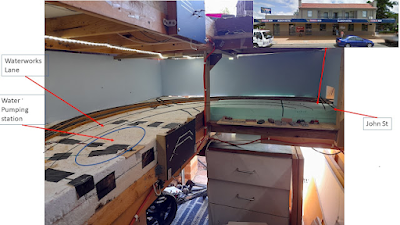
In an earlier post, I wrote about my plans for the part of the layout immediately 'north' of the lower staging yard. Leaving Singleton  Notionally, it is that small portion of the Main North between Singleton and the Hunter River bridge.

The adjacent photo shows the concept for this section as detailed in the earlier post. The scratch-built Albion Hotel is one of key elements of that concept. A paling fence has been used to contain the hotel yard and level crossing lights have been installed adjacent to the hotel on John St.

The scenery construction followed my usual practice of Woolworths 'domestic wipe' disposable towels overlaid with coloured tile grout and then static grass. The very basic backdrops have been hand painted using artist's acrylics. The level crossing lights at John Street and associated flasher unit are HMA products.

While it has taken a while, in many respects, this work is a just an in-fill before the more challenging work associated with the Hunter River crossing. Consequently, a number of details have yet to be added but I don't anticipate this will happen until other scenery elements have been completed. The outstanding tasks include:

  • The back drop including the gaping access to the staging area needs much more work. The foreground of the back drop needs a more urban appearance and the hole need to be screened, possibly with some trees. I also need to work on a method of activation for the level crossing lights. This will be a process of trial and error for me. 


  • Again, the backdrop needs more work to reflect the transition from township to open country. A few more rural fences and isolated trees would probably also enhance the scene.


  • The tree line in the foreground of the backdrop intends to show the course of the Hunter River disappearing into the distance as it meanders its way east towards Newcastle. This needs to be integrated with the bridge site. The water pumping station and associated buildings will also be added.


That said, at least now as 5069 departs Singleton to collect a load of coal from the Philip's Creek Colliery, it's no longer passing through the stark barren white and green landscape shown in the photo at the top of this post. More to follow!


Tuesday, 19 December 2017

Not Quite a White Christmas

Work on scenery for the Kingston Plains module continues and as the shape of the basic topography is now settled, the module has taken a distinctly blue hue as the absorbent towelling has been glued in place. As an aside, the inspirational photo taped to the back drop was taken from Ian Dunn's article, 'Moving the Golden Grain', in the April 2006 issue of AMRM. It shows a great view of the Merriwa branch line terminus in 1970.
 

As I mentioned in an earlier post, Terraforming - aka making a mess , the next step will be to apply a slurry of the coloured tile grout mixed with of 50/50 PVA/water. Most modellers have their own favourite technique for this stage and I'm no different. My experience has been that the slurry, once cured, provides a robust pre-coloured base upon which to add other scenery elements. Over time, I have settled on a Davco tile grout product that I can source from my local Bunnings mixing a light brown (ten parts of item number 27 or 28) with a Red brown (one part of item number 38).[Update Jan 18 - a recent visit to Bunnings indicates that Davco have changed their coding and colour range. Some experimentation will be required but the mix of a light brown and red brown should work]
  

 The two flanking photos show the view from either end of the module. The wheat silo will be located where the glue bottle is standing and should be the dominant scenic feature for Kingston Plains.


It's a bit hard to believe that Christmas 2017 is rapidly approaching, but it is and consequently, this will be my final post for 2017. If I've been extra good enough this year, an elderly ALCO may find its way onto the Philip's Creek locomotive roster in 2018. Then again, even a lump of coal might be useful as it could be crushed and used to fill the coaling stage at Kingston Plains.

More importantly however at this time of the year, I would like to acknowledge  those individuals who have assisted me with comments, advice and information, all of which have enhanced my modelling activities in 2017.

And finally, to all readers, best wishes to you and your family for a very Merry Christmas and a very happy 2018.